Can Boiling Water Damage Your Plumbing Pipes?
Pouring boiling water down a slow drain is repeated household advice. Whether it is harmless depends entirely on what your waste pipes are made of.
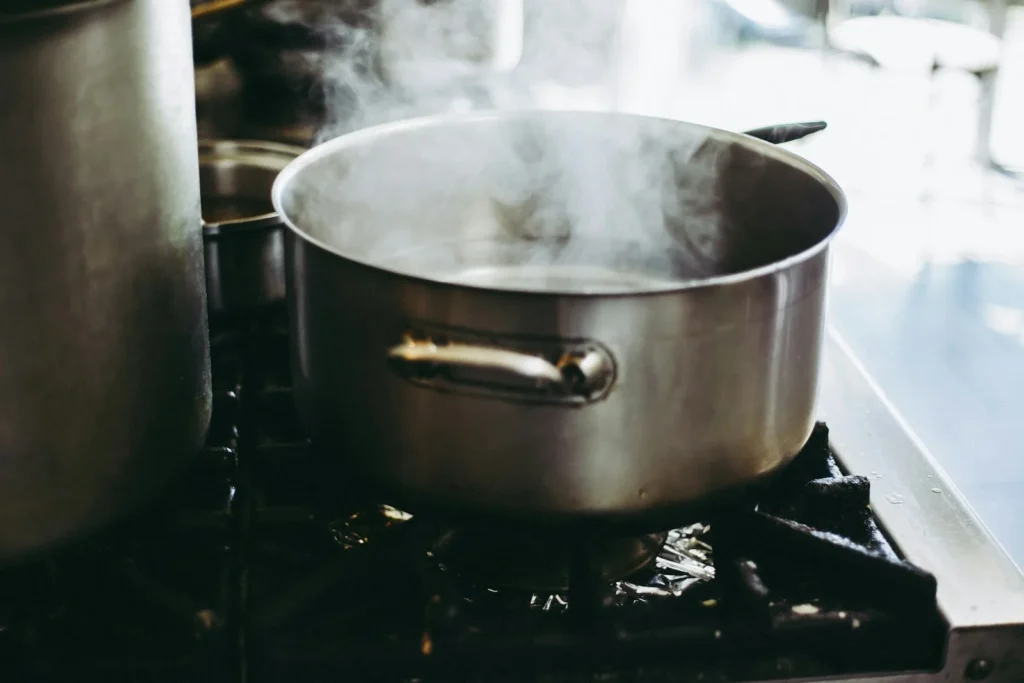
Pouring a kettle of boiling water down a slow drain is one of the most repeated pieces of household advice there is. It is also one of the few that can turn a minor blockage into a repair, depending entirely on what your waste pipes are made of.
The short answer
Boiling water is a real risk to plastic waste pipe, to the seals in any drain assembly, and to porcelain fixtures. It is generally fine for metal pipe.
Most homes built or re-plumbed in recent decades have plastic drain lines, which is why the old advice has aged badly. Very hot water from the tap achieves most of the same benefit without the risk.
What it does to plastic waste pipe
PVC is the common material for household drain lines, and it is not rated for boiling water. Manufacturers give maximum service temperatures well below the boiling point, because the material softens as it approaches them.
A softened pipe can distort, particularly at joints where it is under some stress, and the solvent welded joints themselves are the weak point. Repeated exposure matters more than a single pour. Someone treating a slow drain with a kettle every week is applying a cycle of heating and cooling the pipe was never designed for.
The failure, when it comes, is usually a slow leak at a joint inside a wall or under a floor rather than a dramatic burst. That is the expensive kind.
ABS, the black plastic used in some homes, has similar limits. CPVC and PEX are rated for hot water, but those are supply materials and are not usually what your drain is made of.
Metal pipe
Cast iron, galvanised steel and copper all handle boiling water without difficulty. If your drains are metal, the temperature itself is not the concern.
Worth knowing, though, that many homes are a mixture. An older house may have a cast iron main with plastic branches added during a remodel, so the pipe you can see under the sink is not necessarily the pipe the water reaches next.
Seals, traps and fixtures
Even where the pipe itself copes, the assembly around it may not.
Trap connections rely on rubber and plastic washers, and repeated heat cycling hardens them so they stop sealing. A drain that starts weeping under the sink after a run of kettle treatments is a common enough outcome.
Never pour boiling water into a toilet. Vitreous china does not tolerate sudden temperature change, and a cracked bowl means replacing the toilet. Our article on unclogging a toilet without making it worse covers what to use instead.
The same caution applies to any porcelain or enamelled fixture where the water would sit rather than pass straight through.
Does it even work?
This is the part usually left out. Heat softens grease, which is why the advice exists and why it sometimes appears to work.
What it does not do is remove the grease. It melts it and moves it along the pipe, where it cools against a colder section further from the fixture and sets again. The drain runs freely for a while and then slows, and the deposit is now somewhere less accessible than it was.
Against hair, soap residue, or a solid object, heat does essentially nothing, since none of those melt. Our article on slow sink drains covers what is actually accumulating.
What to do instead
Use hot tap water. It is limited by your water heater’s setting, which keeps it below the temperature that damages plastic, and it carries most of the benefit. Run it for several minutes rather than pouring a kettle.
Remove the obstruction physically. Clearing a stopper or opening a trap deals with the cause rather than relocating it. Our articles on bathroom sink clogs and kitchen sink clogs go through both.
Keep grease out. Letting it set in a container and throwing it out prevents the problem the boiling water was trying to solve.
The scalding risk
Worth stating plainly. Carrying a full kettle of boiling water to a sink, and pouring it into a sink that may already be holding standing water, risks splashback onto hands, forearms and feet.
If the drain is blocked rather than slow, the water has nowhere to go and simply sits there at scalding temperature, which is worse again. That alone is a reasonable argument for using the hot faucet.
When to get help
If a drain has needed repeated treatment of any kind, the treatment is not the answer. A drain that slows again within weeks is describing a restriction that needs removing rather than softening, and our article on why drains keep clogging covers why. See drain cleaning for the work itself.
Frequently asked questions
Is hot tap water safe for drains?
Yes. It is limited by the water heater setting, so it stays below the temperature at which plastic waste pipe softens. Your plumbing already handles it every time you run hot water or empty a bathtub.
How do I know whether my drains are plastic or metal?
Look under a sink. White or black plastic is PVC or ABS. Dull gray metal is usually galvanised steel, and heavy dark pipe is likely cast iron. Bear in mind a house can have both, so what you see may not be what the water reaches next.
Will boiling water and baking soda unclog a drain?
The fizzing is a reaction between the baking soda and vinegar rather than anything happening to the clog, and it produces very little force in an open pipe. It may help with odor. It carries the same heat risk and rarely shifts an actual blockage.
For plumbing service in Houston, call (877) 563-1074 to connect with an independent plumbing service provider.