How to Find Your Home’s Main Water Shut-Off Valve
The time to find your main shut off valve is not while water is crossing the floor. Where to look, how to test it, and what to do if it will not turn.
The time to find your main shut off valve is not while water is running across the floor. It takes ten minutes on an ordinary afternoon, and it is one of the few pieces of homeowner knowledge that can genuinely limit the damage from a burst pipe or a failed water heater.
Most homes have more than one shut off
People talk about the main shut off as though there is one. In practice there are usually several, at different levels, and knowing which is which saves confusion later.
Fixture valves. Small valves under sinks and behind toilets, serving one fixture. Always try these first, because they isolate the problem without turning off water for the whole house.
The house main. One valve controlling every water outlet in the building. This is the one this article is about.
The meter or street valve. Owned by the utility, at the property boundary, controlling supply to the property.
Our note on where to shut your water off covers working down that order in an emergency. What follows is about finding and understanding the house main itself before you need it.
Where to look
The main valve sits where the supply line enters the building, so the search starts by working out which side of the house that is. The meter box at the boundary points towards the entry, because the line generally runs the shortest sensible route from one to the other.
Homes on a slab, common across much of the South. Look along the perimeter wall facing the meter, often close to an outdoor faucet, and frequently on the outside of the house. Garages and utility rooms are also common, particularly near the water heater.
Homes with a basement or crawl space. Usually inside, on the wall facing the street, within a few feet of where the pipe comes through.
Apartments and condominiums. Often a valve serving only your unit, in a utility closet, behind an access panel, or near the water heater. Building management will know, and it is worth asking before you need it.
Follow the largest cold pipe you can find backwards. It leads to the entry point, and the valve is close to it.
The two types, and why it matters
Knowing which type you have tells you what to expect when you turn it.
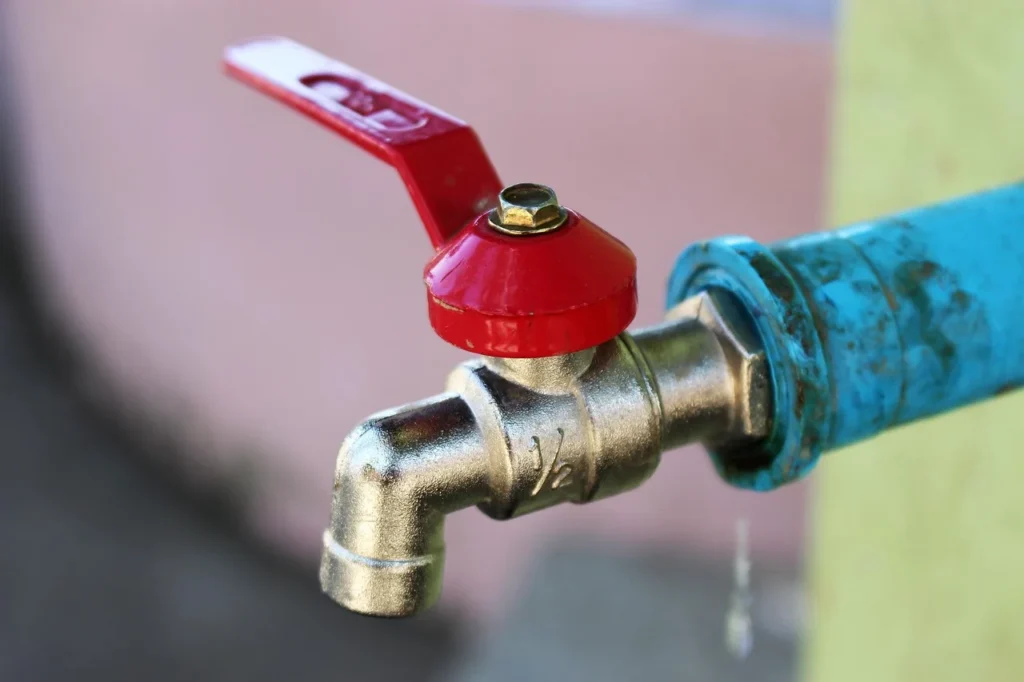
Ball valves have a straight lever handle. A quarter turn closes them completely. The handle in line with the pipe means open, across the pipe means closed, so you can read the state at a glance. They are reliable and the usual choice in newer work.
Gate valves have a round wheel handle and need several full turns to close. They are common in older homes, and they are the ones that cause trouble. A gate valve that has sat untouched for years often seizes, and the internal gate can corrode or detach, so the handle turns freely while the valve stays open.
Both close clockwise. The old rule of righty tighty applies.
Test it before you need it
Finding the valve is only half of it. A valve you have located but never operated may not work, and discovering that during an emergency is the worst possible time.
Pick a dry afternoon. Close the valve, then open a faucet somewhere in the house and confirm the flow stops rather than just weakens. A valve that reduces the flow without stopping it is not going to protect you.
Then open it again, fully, and check the faucet runs normally. Leaving a main partly closed causes low pressure throughout the house, and it is a surprisingly common cause of a mystery that gets blamed on something else entirely.
Two cautions. Turn slowly, because closing a main quickly can produce a pressure shock. And be ready for an old valve to weep slightly from the stem once moved, which is usually a packing nut needing a gentle tightening rather than a disaster.
If it will not turn, or will not stop the water
Do not force it. A corroded gate valve can snap, and then you have an open pipe and no valve at all.
A seized or failed main is worth replacing as a planned job, which is exactly the sort of thing that is cheap when arranged and expensive when discovered mid emergency. In the meantime, find out where the meter valve is, because that becomes your fallback.
The meter valve is usually in a box at the boundary, often under a metal or plastic lid at ground level. Lift the lid carefully, since these boxes are popular with insects and occasionally snakes. Some need a meter key, an inexpensive tool worth owning if that is your only working shut off.
Some utilities prefer that customers do not operate the meter valve, and a few seal it. If yours is sealed or you are unsure, your water provider can tell you their policy, and that is a better conversation to have in advance.
Label it, and make sure others know
Knowledge that lives in one person’s head is not much use when that person is away.
Tie a bright tag to the valve. Photograph it, including a wider shot showing where it is, and keep that on your phone. Show everyone in the household, including anyone old enough to be home alone, and tell house sitters and tenants.
Keep the area around it clear. A valve behind stacked boxes in a garage is a valve you cannot reach quickly, and that is exactly when you need it.
If you have a gas water heater, it is worth knowing where the gas shut off is at the same time, since a serious water event may mean isolating both.
After you shut the water off
Closing the main stops the supply, but the pipes in the house are still full. Opening the lowest faucet in the building, and one upstairs, lets that remaining water drain down and out rather than through whatever is leaking.
If you have an electric water heater and the water will be off for any length of time, switch it off at the breaker, so it cannot heat with no water coming in. On a gas unit, turn the control to the pilot or off setting.
Our pipe burst emergency checklist sets this out step by step, and our article on what to do when a pipe bursts covers what follows.
When it is worth getting help
Reasonable reasons to ask are a main you cannot find, a valve that will not turn or will not stop the flow, a valve that leaks once operated, no accessible shut off at all, or a gate valve old enough that you would rather not rely on it.
Replacing a main shut off is a straightforward planned job and an unpleasant emergency one. See plumbing repair, or emergency plumbing if water is already escaping. If the concern is a water heater, a heater leaking from the bottom covers isolating that unit specifically.
Frequently asked questions
Which way do I turn the main water valve off?
Clockwise. A lever handle needs a quarter turn to sit across the pipe. A wheel handle needs several full turns. Turn slowly, and confirm at a faucet that the water has actually stopped.
What if I cannot find the main shut off valve?
Locate the meter box at the property boundary and work back towards the house from there, since the valve is usually near where the line enters. If there genuinely is not one, that is worth putting right rather than living with, and the meter valve is your fallback meanwhile.
How often should I test it?
Once or twice a year is plenty, and it also keeps the valve from seizing. Valves that are never operated are the ones that fail when they are finally needed.
For plumbing service in Houston, call (877) 563-1074 to connect with an independent plumbing service provider.