Signs Your Water Pressure Is Too High
Most people call about water pressure when there isn’t enough of it. Too much pressure generates far fewer calls, which is unfortunate, because it’s the version that quietly costs money. Nothing stops working. Things just fail earlier than they should, in ways that rarely get connected back to the cause.
What Counts as Too High
The International Plumbing Code addresses this in section 604.8. Under that provision, where water pressure within a building exceeds 80 psi static, an approved pressure-reducing valve conforming to ASSE 1003 or CSA B356, fitted with a strainer, is required to bring distribution piping down to no more than 80 psi static.
That gives you a useful reference point. Two things are worth understanding about it, though.
First, the IPC is a model code. It applies to a given property only where a jurisdiction has adopted it, and adopted codes differ in edition and in local amendments. Treat 80 psi as the widely used industry benchmark rather than as an automatic legal fact about your address, and confirm what actually applies where you live.
Second, supply pressure varies between areas and across the day. If your readings look unusually high, it’s worth raising with your water provider, who can say whether anything in your area accounts for it. Depending on the system and the requirements that apply locally, pressure regulation on the property may also be needed.
A regulated pressure below the 80 psi benchmark is common, but the appropriate setting depends on the property and the requirements that apply locally.
The Warning Signs
No single one of these proves high pressure. Several together make it worth measuring.
- A bang when a faucet or appliance valve shuts. Higher pressure means faster-moving water, so the shock when it stops is harder.
- Faucets that start dripping again soon after being repaired. New washers and cartridges failing within months says something about what they’re being asked to hold back.
- Toilet flappers and fill valves needing replacement repeatedly. Same reasoning, cheaper parts.
- The water heater’s relief valve discharging. That valve opens on temperature or pressure. If it weeps with no temperature problem, supply pressure is a candidate.
- Appliance inlet valves failing. Washing machines and dishwashers use solenoid valves that live shorter lives under sustained high pressure.
- Flow that feels aggressive rather than strong. Faucets that spit, splash, or are hard to throttle down to a trickle.
- Running toilets across the house at once. Several fixtures developing the same fault at the same time usually means something systemic.
Pressure that has climbed recently tells you more than pressure that has always been high. If these symptoms began after work on the street, a meter replacement, or a new regulator, that timing matters.
The Check You Can Do Yourself
This needs no tools beyond an inexpensive gauge from a hardware store.
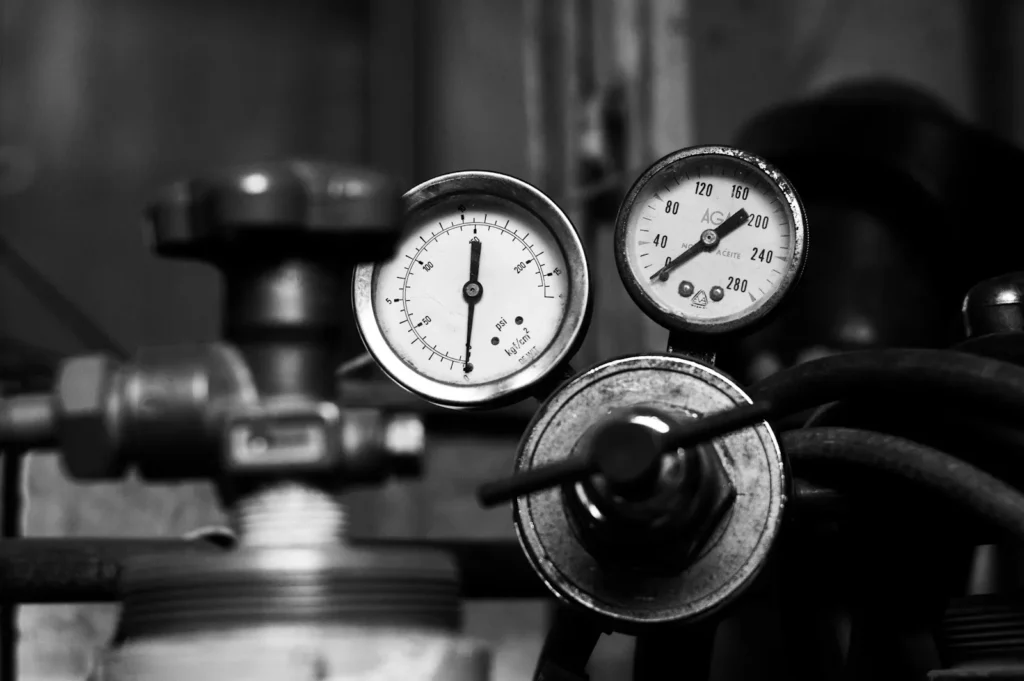
Screw a pressure gauge onto an outside hose bib, or onto the laundry cold tap, and open the valve fully. Read it with no water running anywhere in the house. That’s your static pressure.
Two refinements make the reading more useful. Take it at different times of day, because supply pressure varies with demand and is often highest overnight. And if you already have a pressure-reducing valve, a reading that climbs steadily while everything is off can point to thermal expansion in a closed system rather than to high supply pressure alone.
While you’re looking, check whether a regulator exists at all. It’s usually a bell-shaped brass fitting on the main line where it enters the property, often near the meter or where the pipe comes through a wall. Some properties have never had one.
Why It’s Worth Correcting
The damage is cumulative rather than dramatic. Every joint, seal, valve and flexible connector in the house spends its life holding back more force than it was specified for, and the failures show up as a slow attrition of small components. Occasionally something gives way at full pressure instead of weeping first, which is a different kind of afternoon. Our guide to what to do when a pipe bursts covers that scenario.
High pressure also wastes water invisibly, since every open fixture delivers more than it needs to, and it keeps the water heater under constant strain.
When to Get It Evaluated
Adjusting or replacing a pressure-reducing valve isn’t a good improvisation project. Set too high, it defeats the point. Set too low, every shower in the house suffers. And the valve sits on the main supply, so mistakes are wet ones.
It’s reasonable to bring in a professional when a gauge reading sits above the 80 psi benchmark, when pressure is erratic rather than steady, when no regulator is present and the reading is high, when the water heater relief valve is discharging, or when the same small components keep failing. Plumbing repair covers this kind of component work, and faucet repair covers the fixtures that tend to show symptoms first.
If you’re weighing a pressure problem against other unexplained plumbing behavior, common plumbing problems is a useful place to start narrowing things down.
If a gauge reading or a pattern of failing fixtures suggests your pressure is too high, call (877) 563-1074 to connect with an independent plumbing service provider serving Houston.
Frequently Asked Questions
Is high water pressure my water provider’s responsibility?
Supply pressure to the meter comes from the distribution system, and your provider can tell you what’s normal for your area and whether anything has changed. Pressure regulation within the property is a separate question, and whether it’s required depends on the system and on the code requirements adopted locally. Asking both parties is reasonable.
Can high pressure cause a running toilet?
It can contribute. Fill valves and flappers are inexpensive rubber and plastic parts holding back the full supply pressure, and they wear faster under sustained load. If several toilets develop the same fault in a short period, pressure is worth measuring before replacing anything else.
How long does a pressure-reducing valve last?
There’s no fixed lifespan. It depends on water quality, how hard the valve works, and whether debris has passed through it. They’re mechanical and they do eventually fail, sometimes gradually and sometimes by letting pressure straight through. A failing regulator is a common explanation when pressure changes suddenly with no other cause.
Source: ICC, International Plumbing Code §604.8, Water pressure-reducing valve or regulator (2021 and 2024 editions).